
Moving out of a single-fronted inner-west cottage: the street, the rear lane and the truck two doors down
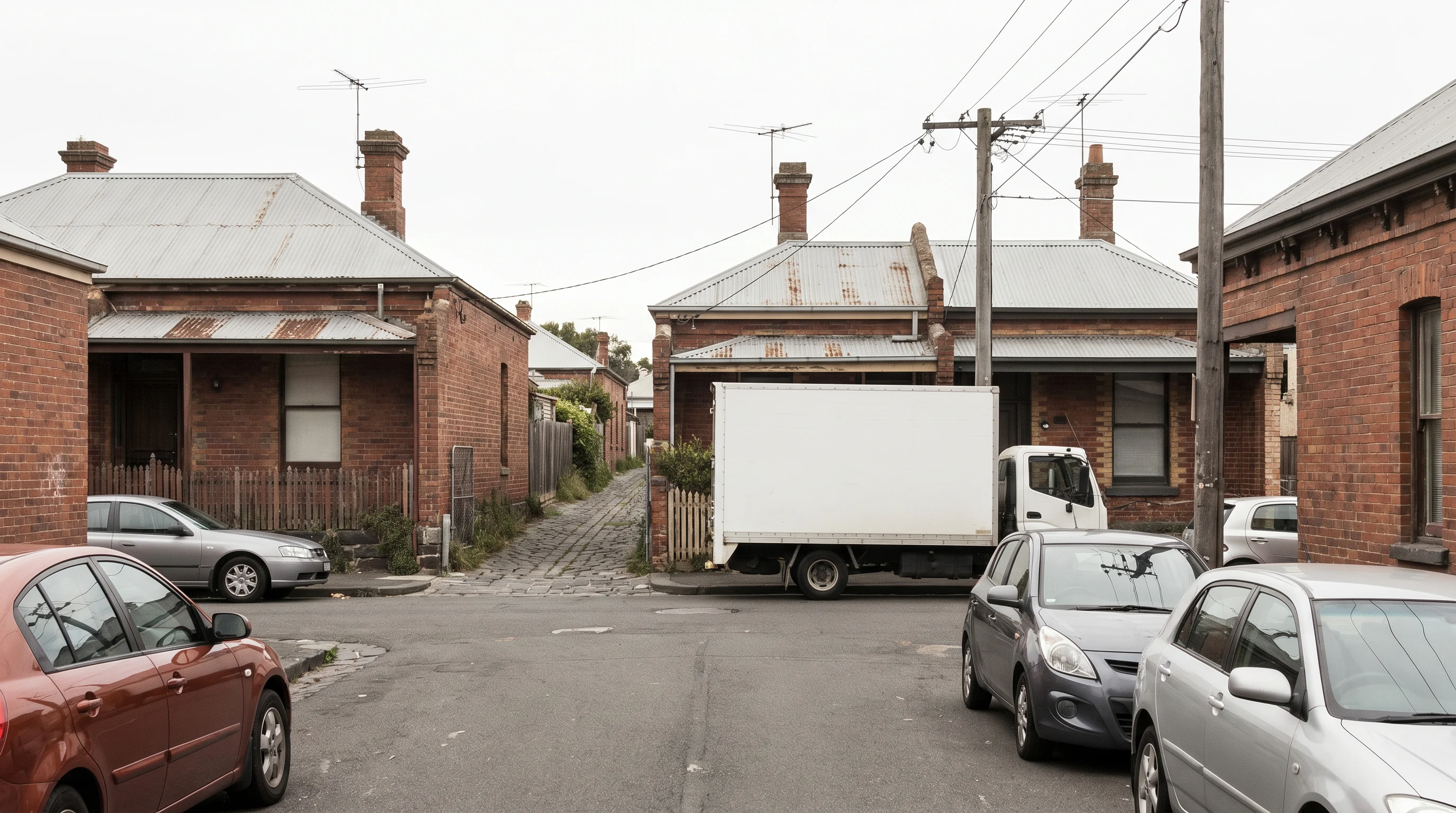
If you have ever watched a removal truck try to find a spot on a single-fronted street in Yarraville, Seddon or Footscray, you already know the real challenge of an inner-west move. It is rarely the size of the house. A two-bedroom workers’ cottage does not hold that much. It is that the house was built in the 1880s for a horse and cart, on a 40-foot frontage, with no driveway, on a street that is now parked solid on both sides. The truck, more often than not, ends up two doors down.
That is not a disaster. It is just a move that has to be read before it is loaded, and the good news is that the things that make these streets hard are knowable in advance. Here is how we plan one.
The street decides the truck, not the house
The first question on a cottage move is never “how big is the house”; it is “what will the street take”. Seddon is the clearest example: its grid is deliberately misaligned, several streets are dead-ends, and a former tram route through the village was replaced with garden-bed medians that narrow the carriageway. A full-size pantech can be the wrong tool there, because it cannot turn, cannot park legally near the door, and ties up the street for everyone.
So we size the truck to the street. Sometimes that is a smaller, more manoeuvrable truck that can actually get close; sometimes it is a normal truck parked at a scouted legal spot with the crew carrying the extra distance. Either way the decision is made before the day, not improvised in front of your house while the clock runs.
The rear right-of-way is your secret weapon
Many inner-west cottages back onto a traditional rear right-of-way, a narrow lane that once took the nightcart and now mostly holds bins and the back gate. For a move it can be gold. If the lane gives a shorter, flatter carry than hauling everything down a long hallway and out onto a tightly-parked street, we will use it, with the gate propped, the path cleared and protection laid.
It is not always the answer; some lanes are too narrow, too rough, or gated in a way that does not help. But it is always worth checking, and it is the kind of thing a crew that knows these streets looks for and a crew that does not will miss.
The arterials you cannot use
One genuinely local wrinkle: several of the arterials that ring Yarraville, including Francis Street, Somerville Road and Williamstown Road, fall under Melbourne’s inner-west truck-ban scheme, and the Anderson Street level crossing is changing too. That means the most direct road for a heavy vehicle is not always a road a removal truck is allowed to take. We plan a legal route in, so the truck arrives at your street without a detour or a fine, and we keep an eye on the live roadworks around Spotswood and Newport while we are at it.
What this means for your quote
All of this is why an honest inner-west quote asks about the home and the access, not just the number of bedrooms. A cottage with a usable rear lane and a quiet street is a very different job from an identical cottage on a dead-end with no lane and a school pick-up zone out front. Tell us which you have, or run it through our Move Planner, and the quote will already understand your move before we arrive.
Common questions
There is nowhere to park a truck outside my cottage. What happens on the day?
It is the norm on single-fronted streets, so we scout a legal loading spot in advance and choose a truck sized to the street rather than the biggest pantech. The crew carries from there, and we lay floor and doorway protection along the path.
Can you use the rear laneway behind my terrace instead of the street?
Often, yes. Many inner-west cottages have a traditional rear right-of-way, and where the lane gives a shorter or safer carry than a tightly-parked street we will use it. We look at both before the day and pick the one that protects your home and keeps the move efficient.
Do I need a council permit to park the removal truck?
Usually not. None of the inner-west councils has a dedicated removalist permit; the formal option is a road-occupation permit that needs about ten days notice, but for most cottage moves we simply scout and time a legal spot. We will tell you if your move genuinely needs reserved space.
Planning a move?
Get a free, no-obligation quote and we'll plan the access at both ends with you.
Get a quote